


Critical Analysis - “Missing Meaning"
(directed by Vasco Diogo)

“Missing Meaning” announces itself as a mobile-native, AI-suffused rite: a psychedelic traversal through fear, memory, and luminous wonder. The promise is ambitious, an inner-child’s healing woven into a surrender of adult ego, yet the film’s stated horizon of transformation rarely materializes as a sustained, legible experience. Instead, the work disperses into a rapid sequence of effects whose intensity substitutes for coherence. The result is less a ritual than a scroll: a never-ending feed of images, gestures, and textures that overwhelm interpretation and ultimately eclipse the very “meaning” the film seeks to dislocate and rebirth.
From the opening tableaux, a fog-choked ruin where a cartoonish, skull-eyed figure looms beside two small, suited avatars, the film stakes its sensorial thesis on juxtaposition. The spectacle is striking and technically proficient: volumetric mist, saturated neons, and AI-hallucinated architectures hover between dystopia and amusement park. Yet these images do not accumulate as arguments. They function as attractions in Tom Gunning’s sense, set pieces that arrest attention, rather than as nodes within a larger conceptual map. Psychedelia here is primarily an optics: a style of intensity rather than an inquiry into altered states.
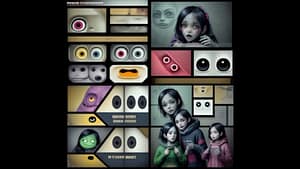
The collage sections underscore that imbalance. Grids subdivide the frame into dozens of micro-windows: faces, avatars, test patterns, painterly smears, and UI-like color bars. The design hints at a meta-commentary on databanks and surveillance of the self; however, the montage remains descriptive rather than analytic. We perceive multiplicity, yes, but the film withholds the connective tissue that would articulate the stakes of that multiplicity, social, psychological, or aesthetic. Where experimental montage can construct conceptual bridges through rhythm and recurrence, these mosaics function as inventory. They enumerate rather than think.
A recurrent alternation between AI-derived fantasy and documentary trace, beach snapshots, streets, civic monuments, seems intended to stage a dialogue between the sacred and the mundane. The black-and-white portraits and landscapes carry the gravitas of memory, and their slowed durations offer a welcome counterweight to the frenetic cascades elsewhere. But even here, the work declines to situate the images within a discernible economy of meaning. The figure at the beach, eyes clenched, becomes an emblematic mask, potentially of pain, sun, or introspective strain, but the film neither returns to this figure with variation nor offers an aural or textual anchor. The images float as unmoored citations of “the real,” quickly absorbed back into the algorithmic tide.

That tide is, unmistakably, today’s: synthetic characters with plush, oversized irises; neon-pink comic-book portraits; LEGO miniatures posed in photoreal plazas; crowds rendered as semi-transparent meshes around a skeletal sentinel. Each shot bears the watermark of a generative pipeline whose default training-data aesthetics have become a lingua franca of the present. To Diogo’s credit, the film does not attempt to hide its dependence on these tools. Indeed, the declaration of “co-participation with technological presence” is philosophically lucid. Yet this candor also exposes a fault line: when a work leans so heavily on ready-made visual grammars, the burden of authorship shifts from image-making to contextualization. What holds these images together, besides availability? What is the film asking us to notice about their provenance, their biases, or their circulation? On these questions, “Missing Meaning” is curiously taciturn.
The project’s spirituality, “without being dogmatic”, positions art as a vehicle for revelation rather than explanation. This stance can be generative, especially when ambiguity compels spectators to complete the work with their own sense-making. But ambiguity requires constraint to be productive. Here the film’s permissive arsenal of techniques (AI image synthesis, voice manipulation, archival snippets, painterly textures, mobile capture) behaves less like a carefully tuned ensemble and more like a plenitude that preempts discrimination. If everything can enter the ritual, nothing defines its perimeter. The sacred event that the film seeks to open never quite arrives because the work declines to name the conditions under which it could appear.

Crucially, the piece also raises a contemporary dilemma: with today’s tools, it has become remarkably easy to produce an “algorithmic expression” of an intuition. The difficulty has migrated from making images to making arguments with images. “Missing Meaning” feels acutely symptomatic of this shift. Its profusion of micro-worlds, cute monstrosities, designer plastics, comic portraits, urban dioramas, maps the horizon of what can be summoned, not what must be said. The film knows how to summon; it is less sure how to insist. Its spiritual lexicon, healing, devotion, transfiguration, remains at the level of aspiration because the work never composes a form strict enough to test those claims.
One might object that coherence is precisely what the film resists: a “state of fragmentation” aligned with an infant’s openness. But even fragmentation, in art, benefits from a logic, anemic or feverish, but felt, by which the shards echo one another. Think of how certain 1960s and 1970s psychotropic cinemas marshaled repetition, motif, and durational rigor to alchemize disjunction into experience. By contrast, “Missing Meaning” often returns not with motif but with novelty. The next striking image arrives before the previous one has had time to ferment. What remains after the procession is less revelation than exhaustion.

None of this negates the film’s isolated strengths. The vertical compositions hold the screen with confidence; the sense of surface, skin, plastic, fog, can be sensuously precise; the commitment to making an inner life visible is sincere. Yet sincerity without structure risks collapsing into pure immediacy. The work tells us that meaning will flicker, disperse, and re-emerge transformed. In practice, meaning flickers, disperses, and then keeps dispersing. The ritual stays preparatory, forever tuning the room, never commencing.
In the end, “Missing Meaning” is undeniably of its moment: a testament to how mobile devices and AI systems have democratized access to image-power. But it also reveals the cost of that access when not yoked to a coherent frame. The film’s most provocative achievement may be inadvertent: it demonstrates that the contemporary problem is no longer a deficit of images but a deficit of orientation. Without that orientation, without a scaffolding that can hold the viewer through the storm, the psychedelic and the experimental remain open categories, capacious enough to absorb almost anything and, for the same reason, too loose to guarantee that something discernible survives the passage. What lingers is a vivid afterimage, not an afterthought. In a work that longs for transformation, that difference matters.

Vasco Diogo was born in Lisbon in 1970. He has a degree in Sociology by Universidade Nova de Lisboa, a master degree in Social Sciences by Universidade de Lisboa and a PhD in Communication Sciences by Universidade Nova de Lisboa, with the thesis: "Video: specificity, hybridity and experimentation"(scholarship by FCT, 2008).
From 2008 to 2020 he was a professor at University of Beira Interior teaching mainly cinema directing, new cinemas and experimental cinema.
After being co-founder of Projecto Teatral, works, since 1998 in performance, video art and experimental cinema around themes such as self-presentation, truth and manipulation. In experimental cinema he has won several international awards (more than 70). He has shown his works in several exhibitions and festivals in Portugal, Spain, Italy, USA, Canada, India, Germany, France, Cyprus, Poland, etc.
Kiriakos Kotsinis
BSc, MA